From Overwhelmed to Optimized: How AI 🤖Empowers Pharmacists 💊

Updated: Mar 22


Sue, an experienced pharmacist with limited technology and specific AI experience, is excited about how AI streamlines documentation, research, and routine administrative tasks. By reducing her daily workload, she frees up time for meaningful, personalized conversations with customers about the best medications to use and how to use them effectively. See below example of how she uses AI daily.


Artificial intelligence isn’t replacing pharmacists, it’s helping them work smarter.
For pharmacists new to AI, the simplest way to think about it is this: AI is a fast, always-available assistant that helps you think, draft, and communicate more efficiently.
1️⃣ Clinical Support
AI can help you:
Think through drug interactions (e.g., warfarin + amiodarone)
Review renal dosing questions
Summarize updated treatment guidelines
Compare medications side-by-side
It doesn’t replace Lexicomp or Micromedex, it helps you reason faster before verifying.
2️⃣ Better Patient Counseling
AI can turn complex medical language into simple explanations:
Create clear scripts for new medications like metformin
Explain side effects in plain language
Draft responses to common patient concerns
This allows you to focus on empathy and patient connection.
3️⃣ Faster Documentation
AI can draft:
SOAP notes
Clinical summaries
Prior authorization justifications
You review and finalize, but you don’t start from scratch.
4️⃣ Inventory & Business Insights (Retail)
For retail pharmacists, AI can:
Identify stockout risks
Highlight high-margin medications
Draft vaccination or refill reminder campaigns
It becomes a lightweight business intelligence tool.
The Bottom Line
AI doesn’t replace clinical judgment. It reduces mental load, saves time, and enhances communication.
Pharmacists who learn to use AI will not be replaced, they’ll simply be more effective.

As pharmacy operations grow more complex, AI offers scalable solutions for workflow optimization, medication safety, and clinical decision support. This video highlights practical use cases that drive measurable impact.

The fastest way for pharmacists to learn AI isn’t by reading about it, it’s by using it. This hands-on experience walks you through real clinical cases, counseling scenarios, documentation, and inventory decisions using practical prompts and sample data. You’ll learn what to verify, how to think critically, and how to turn AI into a daily tool, not just a theory. Move from overwhelmed to optimized.
🏥 SCENARIO 1: Clinical Case Assistant
🧪 “Sample Patient Data” to be used for the exercise.
Patient:
Age: 68
Weight: 85 kg
Conditions: Atrial fibrillation, Type 2 diabetes, CKD Stage 3
Current Medications:
Metformin 1000mg BID
Lisinopril 20mg daily
Warfarin 5mg daily
Atorvastatin 40mg nightly
New Medication Ordered: Amiodarone 200mg daily
🧠 Exercise 1: Drug Interaction Thinking
We’ll be using the free version of Microsoft Copilot for this exercise. If you’re new to Copilot, click below for a quick guide on how to access it and get started.
Exercise 1a: Copy This Prompt Into Microsoft Copilot AI
"A 68-year-old patient with atrial fibrillation is on warfarin 5mg daily and starting amiodarone 200mg daily. What interaction concerns should a pharmacist monitor and what adjustments may be needed?"
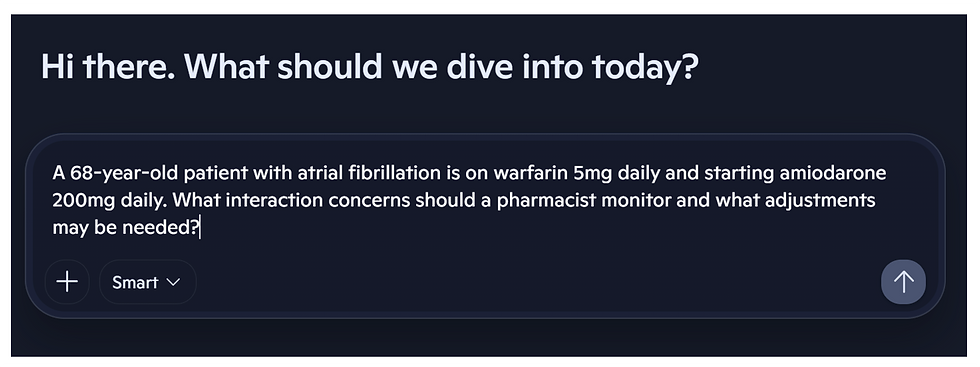
Exercise 1b: Click the "up arrow" in red

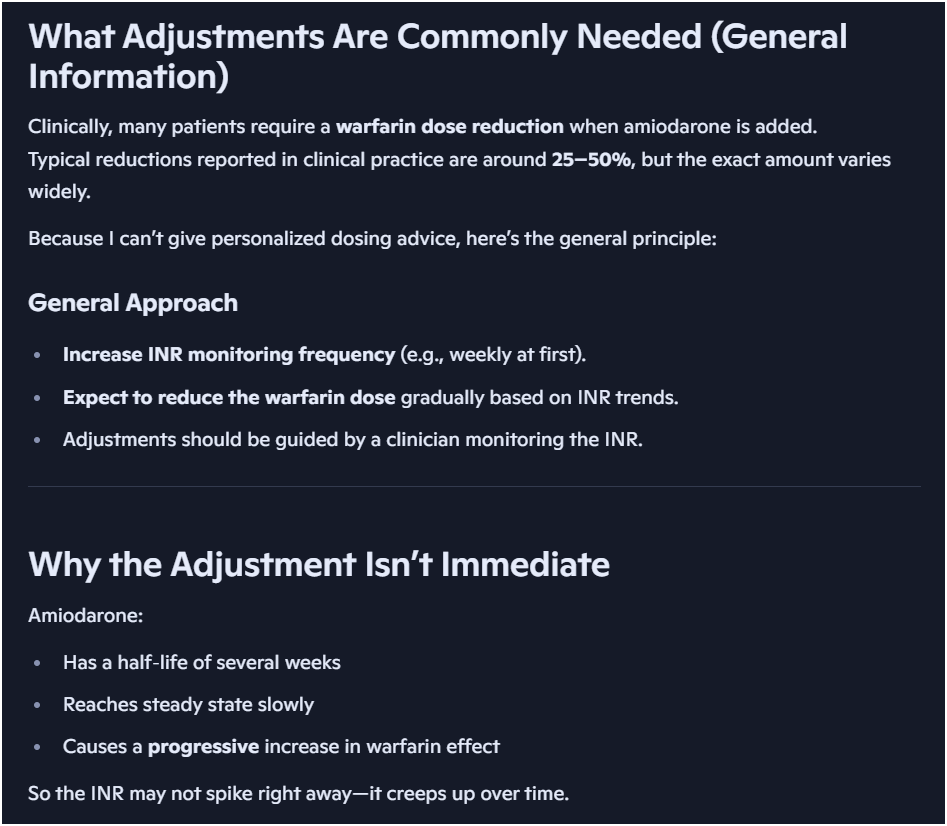
Exercise 1c: Below is an example of what this prompt can produce. Your results may look different. AI can make mistakes, always verify the output using trusted clinical references and your professional judgment.
You should see:
CYP interaction (increased INR)
Recommendation for INR monitoring
Possible warfarin dose reduction (25–50%)
Monitoring timeframe


Exercise 1d: Your Learning Task
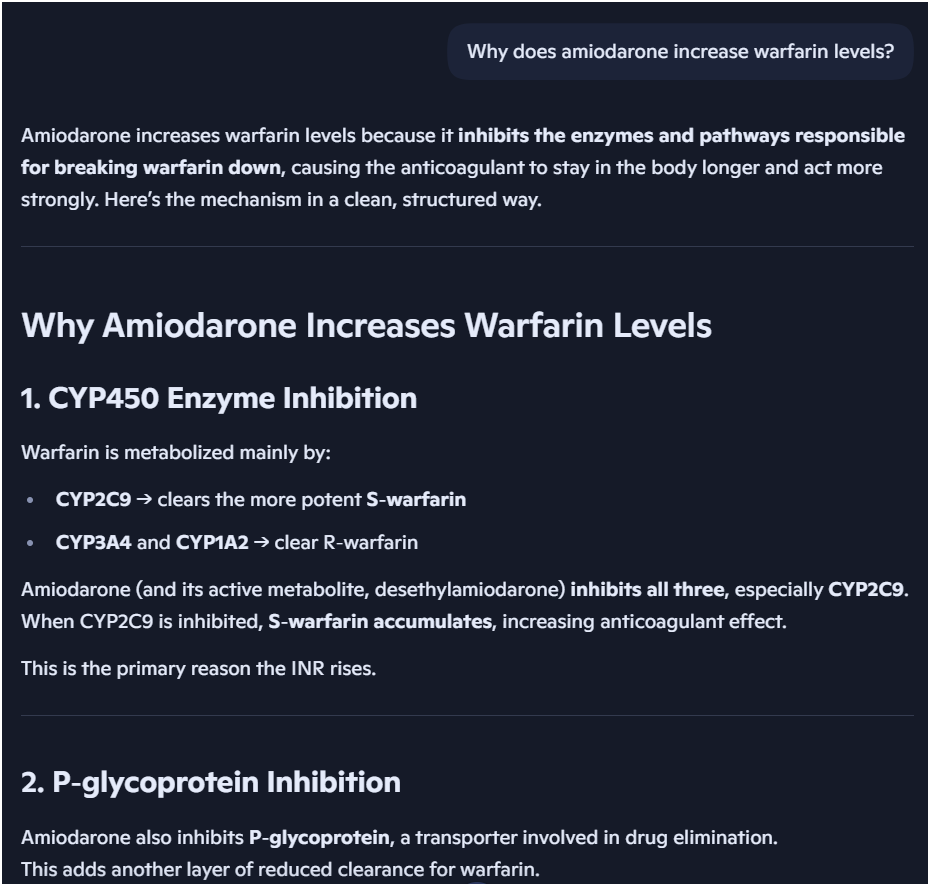
Ask follow-up questions/prompts:
For example: "Why does amiodarone increase warfarin levels?"
This builds pharmacology understanding.

Exercise 1e: CKD Dose Adjustment
AI Question/Prompt:
"This patient has CKD stage 3 (eGFR 45). Is metformin dosing appropriate?"
Check:
eGFR threshold guidance
Risk of lactic acidosis
Monitoring advice


💬 SCENARIO 2: Patient Counseling AI Practice
Exercise 2a: Begin a fresh Copilot session, click the “Start New Chat” button highlighted in the red box below.

"Sample Patient Data" to used for the exercise
Patient:
45-year-old newly diagnosed diabetic
Starting: Metformin 500mg BID
Exercise 2b: Counseling Script
AI Question/Prompt:
"Explain metformin to a newly diagnosed diabetic patient at a 6th grade reading level."
Remember to click the "up arrow".

Exercise 2c: Always verify AI-generated results. Below is a sample output, your results may vary.
You should get:
What it does
Common GI side effects
Take with food
When to call doctor


Note: Click on any item in the red box to view the sources AI used to generate its response.
Exercise 2d: Side Effect Conversation
AI Question/Prompt:
"A patient says metformin causes diarrhea. How should a pharmacist counsel and manage this?"
Look for:
Take with meals
Slow titration
Extended-release option
Temporary adjustment advice


📊 SCENARIO 3: Retail Inventory Optimization
Exercise 3a: Begin a fresh Copilot session, click the “Start New Chat” button highlighted in the red box below.
"Sample Patient Data" to used for the exercise
Now we move to business AI thinking.
📦 Sample Pharmacy Sales Data (Fake)
Drug | Monthly Units Sold | Profit per Unit | Current Inventory |
Ozempic | 60 | $45 | 30 |
Lisinopril 20mg | 200 | $3 | 600 |
Amoxicillin | 120 | $4 | 50 |
Atorvastatin | 180 | $5 | 400 |
Insulin Glargine | 40 | $30 | 15 |
Exercise 3b: Reorder Strategy
AI Question/Prompt (Cut and paste the below into CoPilot):
"Here is my pharmacy sales data:
Drug | Monthly Units Sold | Profit per Unit | Current Inventory |
Ozempic | 60 | $45 | 30 |
Lisinopril 20mg | 200 | $3 | 600 |
Amoxicillin | 120 | $4 | 50 |
Atorvastatin | 180 | $5 | 400 |
Insulin Glargine | 40 | $30 | 15 |
Which medications are at risk of stockout and what reorder strategy would you suggest?"
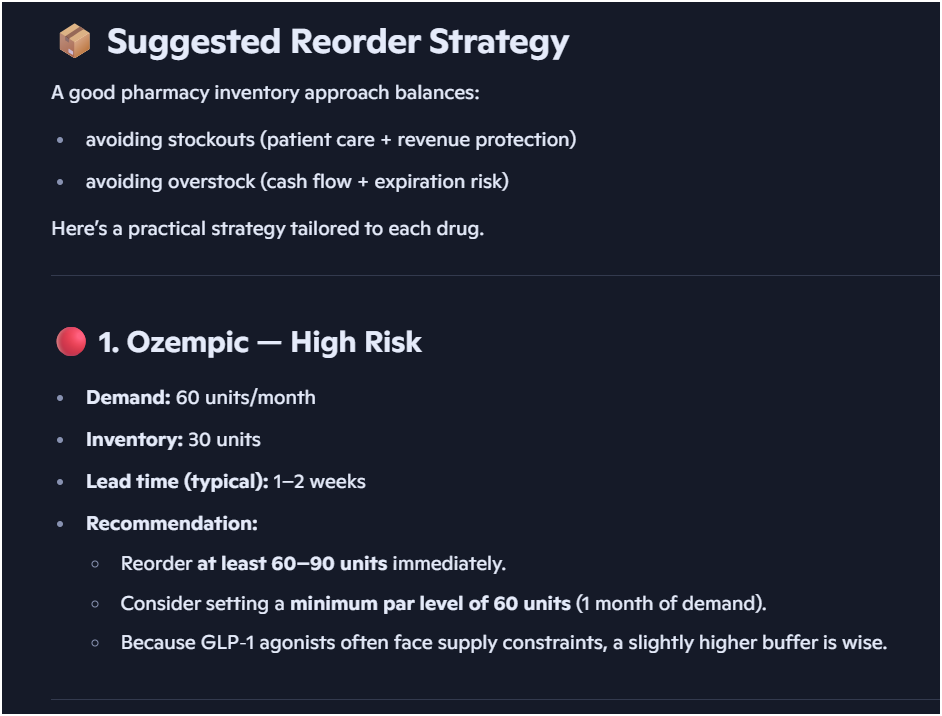
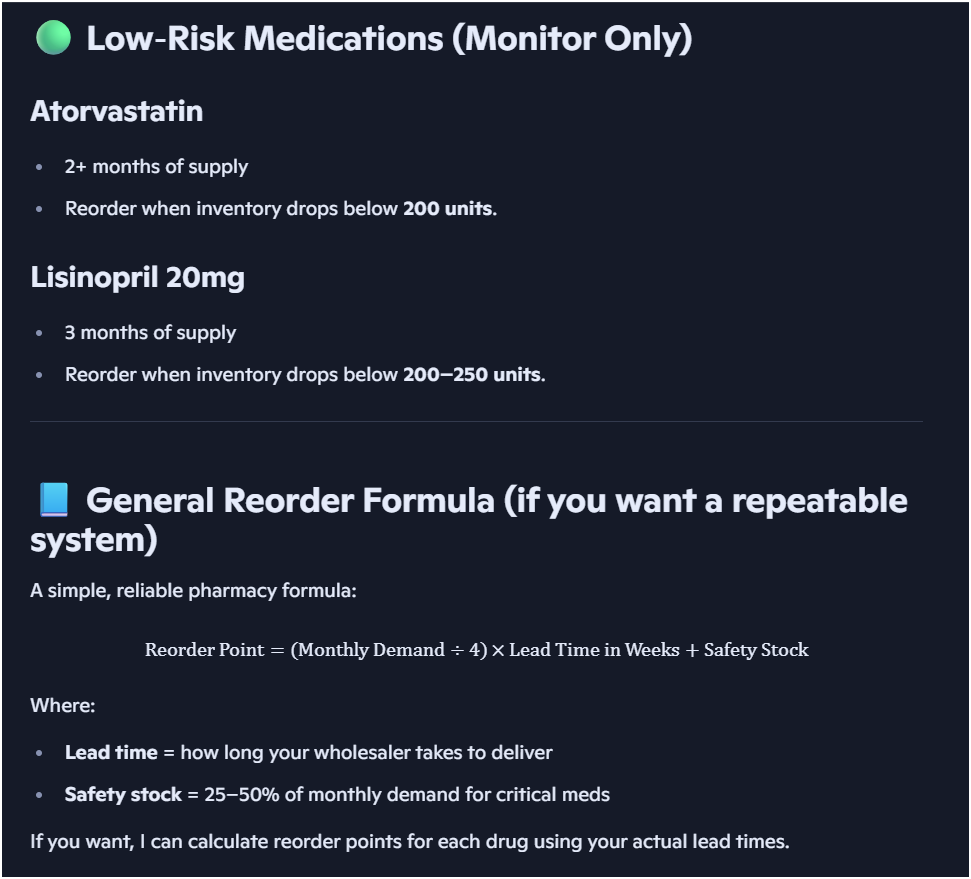
You should see:
Ozempic → high risk
Amoxicillin → high risk
Safety stock suggestions
Reorder timing advice



Exercise 3c: Profit Optimization
AI Question/Prompt:
"Based on this data, which medications contribute most to gross profit and how should I focus marketing efforts?"
You’ll learn:
Revenue = Units × Profit
Focus on high-margin + high-volume items


We hope you enjoyed exploring these hands-on scenarios and experienced the power of AI, while reinforcing that pharmacists remain the final authority through verification, clinical judgment, and professional responsibility.


