The New Competitive Edge for Early-Career Professionals

Updated: Aug 23

The "entry-level" job market has reached a fever pitch. For recent graduates, a degree is no longer a golden ticket, it is simply the baseline. Today, the most successful candidates aren’t just looking for a seat at the table; they are positioning themselves as the AI-bridge for the organizations they join.
The Paradox: A Crowded Market vs. A Skills Gap
It’s no secret that landing your first role is challenging. However, while the market is crowded, hiring firms are facing a unique crisis: they know they need Artificial Intelligence to remain competitive, but their existing workforce is often too busy with "business as usual" to learn how to implement it.
This is your opening. The script has flipped. Organizations are no longer just looking for entry-level support; they are hunting for 'AI-native' hires who can reverse-mentor senior leadership on efficiency. You aren't just a candidate with a degree, you are a Digital Transformation Agent whose expertise is anchored in your major.
From Assignment to Asset: The Finance Major Example
Consider the exercise we just completed. A traditional analyst might spend 6 to 10 hours manually cleaning messy spreadsheets, reconciling "ABC Corp" with "abc corporation," and fixing broken date formats across three different divisions.
An AI-savvy candidate, however, uses the experience gained during their studies to:
Standardize massive datasets in seconds using Large Language Models (LLMs).
Automate the consolidation of regional revenue reports.
Generate executive-level insights and visualizations instantly.
By walking into an interview and demonstrating how you used AI to turn a day-long manual task into a 10-minute automated workflow, you prove you can help the firm’s existing team reclaim their most valuable asset: time.
How to Leverage This in Your Search
To stand out, you must change your narrative from "I am looking for an job or internship" to "I can help your team leverage AI."
Show, Don't Just Tell: Don't just list "AI" as a skill on your resume. Describe a specific project where you used AI to solve a complex data problem or streamline a process.
Be the Educator: In interviews, explain that you are eager to share your AI workflows with the broader team to help drive departmental efficiency.
Highlight the "Human" Plus: Emphasize that because AI handles the data cleaning, you are free to spend more time on high-level strategic analysis, the part of the job that actually moves the needle.
The Bottom Line
The "Early Career" tag doesn't have to mean "inexperienced." In the world of AI, your fresh perspective is actually a technical advantage. Use it to show organizations that you aren't just there to learn their ways, you're there to help them find a better way.
Bridge the entry-level gap: Use the below steps to leverage AI as a competitive advantage for landing your target job or internship.
Using AI to eliminate manual, repetitive work, in any role
To identify where AI can provide the most value, you must move beyond general ideas and look at the "mechanical" level of your daily workflows. By documenting the friction points in a process, you can use AI to pinpoint exactly where automation or augmentation will have the highest ROI.
Step-by-Step AI Opportunity Assessment
Step 1: Document the "As-Is" Process
Before involving AI, you must create a granular map of how the work happens today. Create a table or flow map with the following columns:
Step Name: A clear description of the action (e.g., "Reconcile Regional Revenue").
Time to Complete: Average minutes/hours spent on this specific step.
Systems/Tools: Software used (Excel, ERP, Email, CRM).
Data Inputs: What information is needed? (PDFs, CSVs, handwritten notes).
Pain Points: Where are the errors happening? What part of this is repetitive or boring?
Step 2: Categorize the Work
Review your map and look for steps that fit these "AI-Ready" criteria:
High Volume/Repetitive: Tasks done daily or weekly.
Data Translation: Converting data from one format to another (e.g., PDF to Excel).
Unstructured Data: Sorting through emails, long documents, or messy text.
Rules-Based: Logic that follows "If X, then Y" but has too many variables for a simple Excel formula.
Step 3: Consult the "AI Efficiency Analyst"
Load your process map into an AI tool (like Gemini, Claude or ChatGPT). By providing the AI with the full context of your workflow, it can suggest specific tools and techniques to compress those time-intensive steps.
The Generic AI Opportunity Prompt
Use this prompt once you have documented your process. You can either paste your table directly or upload a CSV/Excel version of your process map.
Below is a sample finance process map you can download to use with the below AI prompt:
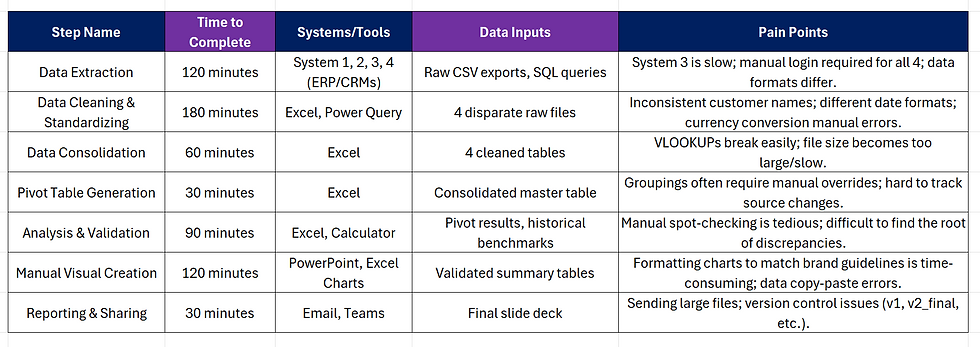
In ChatGPT, Claude, Gemini, or the AI tool you use, Copy/Paste this Prompt with the sample file:
Act as an AI Strategy Consultant. Analyze my uploaded process map to identify the top 3 high-impact steps for AI automation. For each, provide: 1) The specific AI method (LLM, Vision, etc.), 2) Estimated % time reduction, and 3) A complexity score (1-5). Focus on reducing manual effort and errors.
Below is the output from Gemini:
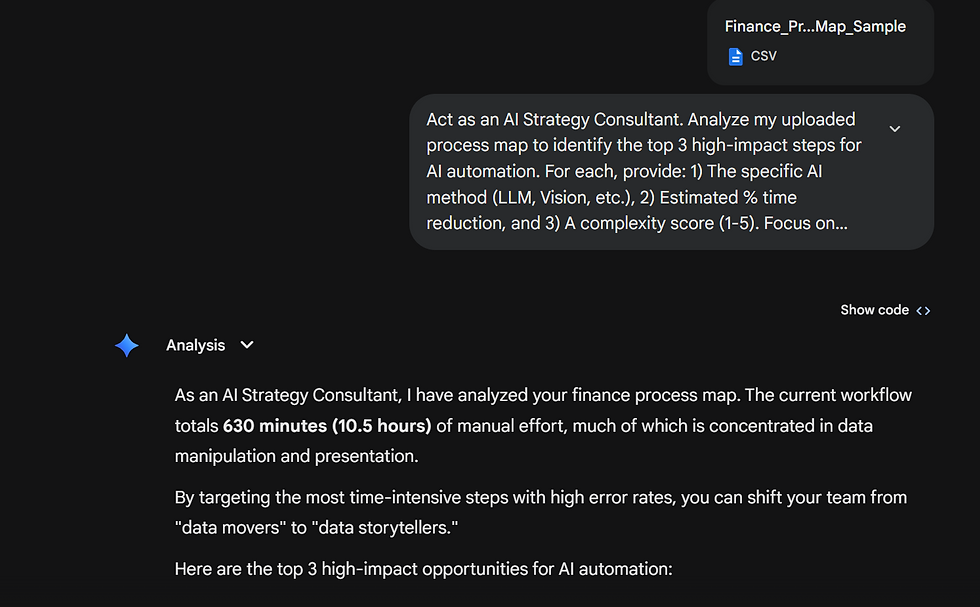

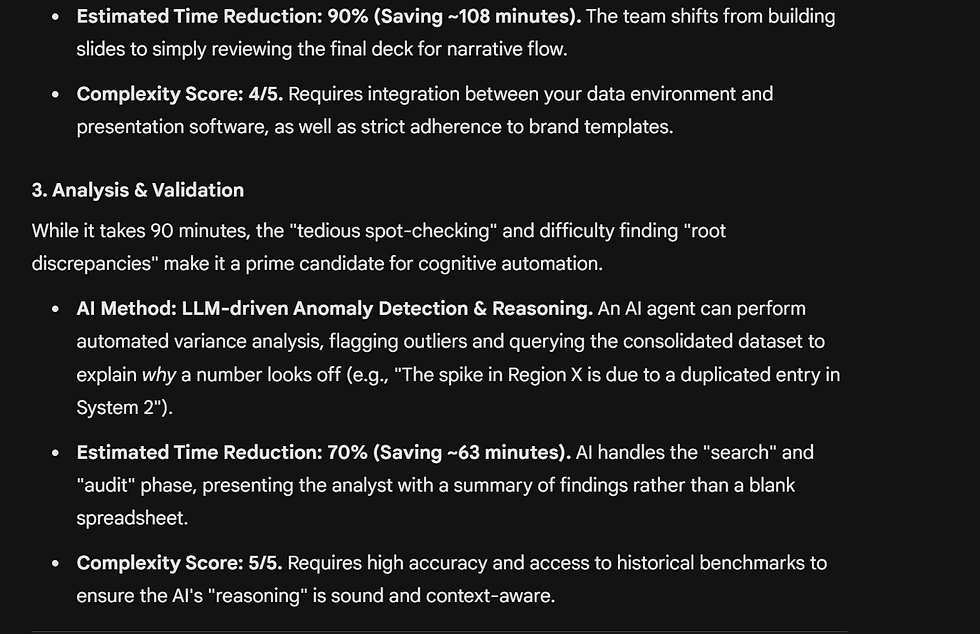

Initial AI strategy mapping identifies data cleansing as a top priority. It offers a 144-minute time reduction with a complexity score of only 2, so we are moving forward with a solution for this step.
Step 4: Automate Finance Data Cleansing via AI
To demonstrate the impact of AI-enabled data cleansing, we will use the below finance data extraction as a practical use case for automation:
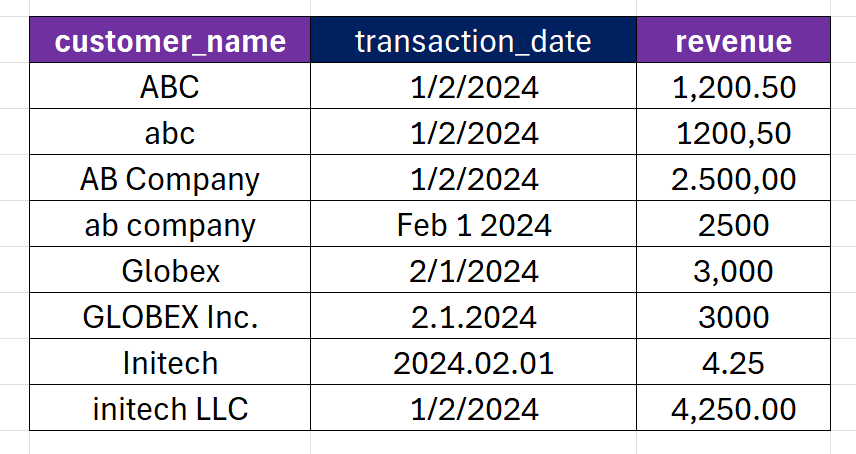
Notice the data quality challenges here: fragmented customer naming conventions and varying formats for dates and revenue create manual bottlenecks that AI is designed to resolve.
In ChatGPT, Claude, Gemini, or the AI tool you use, Copy/Paste this Prompt with the sample file:
You are an AI data standardization engine. Clean the uploaded dataset using the following rules:
1. Standardize customer names (case, spacing, equivalency).
2. Normalize dates to YYYY-MM-DD.
3. Convert revenue formats:
- remove commas
- convert European formats to standard decimals
- enforce two decimal places
4. Identify duplicates after cleaning.
5. Output three tables:
A) Fully cleaned dataset
B) Rows flagged for review
C) Summary of cleaning actions performed
Output is a download file
Below is the output from Gemini:
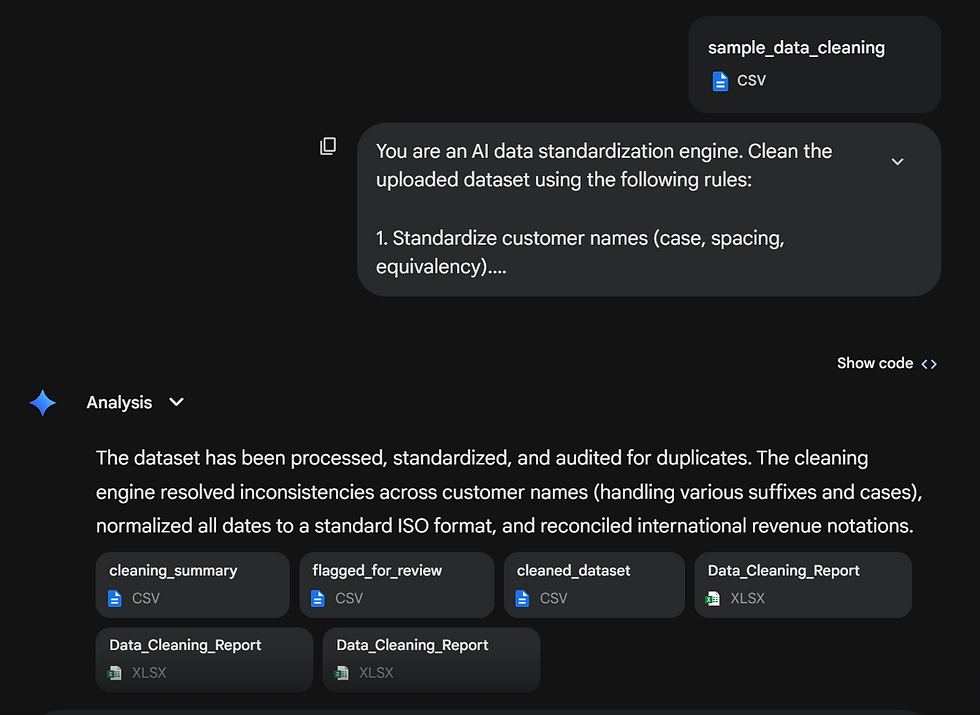

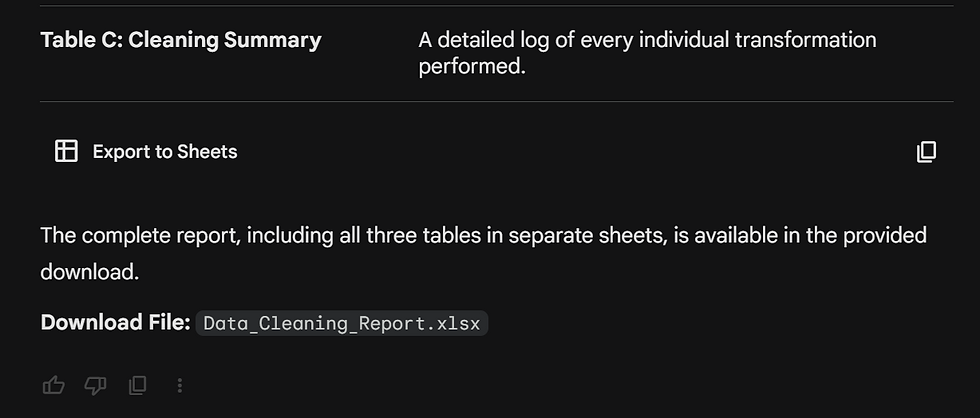
Below is the cleaned data file, which as standardized and cleaned up the data:

We leveraged AI to transform messy raw data into a standardized corporate asset. This eliminated structural inconsistencies and unified customer identities, providing the reliable data foundation necessary for executive-level financial analysis.
Summary of the AI-Enhanced Workflow
Early-career professionals can gain a powerful competitive edge by positioning themselves not just as doers, but as Efficiency Consultants, people who bring AI-driven solutions to improve existing processes. Demonstrating this skill set signals initiative, strategic thinking, and immediate value to any organization looking to hire or offer internships.


